Code: github.com/PhilippMarquardt/isaac-robotics
Teaching a Unitree G1 Humanoid: GR00T, Cosmos Dreams, LiDAR and Parkour
This repository was my playground for testing the open robotics stack end to end on a Unitree G1 humanoid, using rented A100 and H100 GPUs. Rather than focusing on just one model, I worked through five pieces of the pipeline: fine-tuning NVIDIA's GR00T N1.7 on whole-body dexterous teleop data, fine-tuning Cosmos-Predict2.5 plus an inverse dynamics model to generate synthetic training rollouts (the GR00T-Dreams / DreamGen loop), training PPO locomotion and parkour in IsaacLab, reconstructing terrain from a simulated head-mounted LiDAR, and experimenting with a JEPA-style latent-action world model.
first frame + caption  ──►  Cosmos-Predict2.5 (LoRA)  ──►  dream video
                                                               │
                                                               ▼
                                                 inverse dynamics model
                                                               │
                                                               ▼
                                              (state, action) training pairs
                                                               │
                                                               ▼
                                                  GR00T N1.7 fine-tune
Fine-tuning GR00T N1.7 for Inspire hands
GR00T N1.7 (3.14B parameters) ships with a G1 embodiment config, but it assumes simple binary grippers plus navigation commands. The Unitree whole-body teleop datasets I wanted to train on use 6-DOF Inspire hands on both arms and have no navigation commands, so the pretrained action projector couldn't be reused. I registered a new embodiment and trained a fresh action projector together with the 1.1B diffusion transformer action head while keeping the vision-language backbone frozen (1.62B trainable parameters).
The training mix covered six whole-body teleop tasks (~51 GB total):
| Task | Size | Train episodes | Val episodes |
|---|---|---|---|
| Pick up pillow | 5.2 GB | 488 | 121 |
| Collect clothes | 2.0 GB | 269 | 67 |
| Put clothes into washing machine | 3.2 GB | 366 | 91 |
| Put drinks into fridge | 8.6 GB | 240 | 60 |
| Put clothes into basket | 12 GB | 240 | 60 |
| Put vegetables into basket | 20 GB | 240 | 60 |
| Total | 51 GB | 1,843 (~847k frames) | 459 |
Most of the upfront work was data plumbing: converting the datasets from LeRobot v3 back to v2.1 (the format GR00T's loader expects), decoding AV1 videos that OpenCV couldn't open, creating a deterministic 80/20 split with symlinks to avoid duplicating 600 GB of raw files, and recomputing normalization stats whenever the action horizon changed.
Training ran on one A100 80 GB (AdamW, lr 1e-4, batch 32) for about 9.5 hours. I planned for 60k steps, but the disk filled up mid-checkpoint at 18k steps (each full checkpoint with optimizer state is 24 GB). The weights were still intact and recoverable.
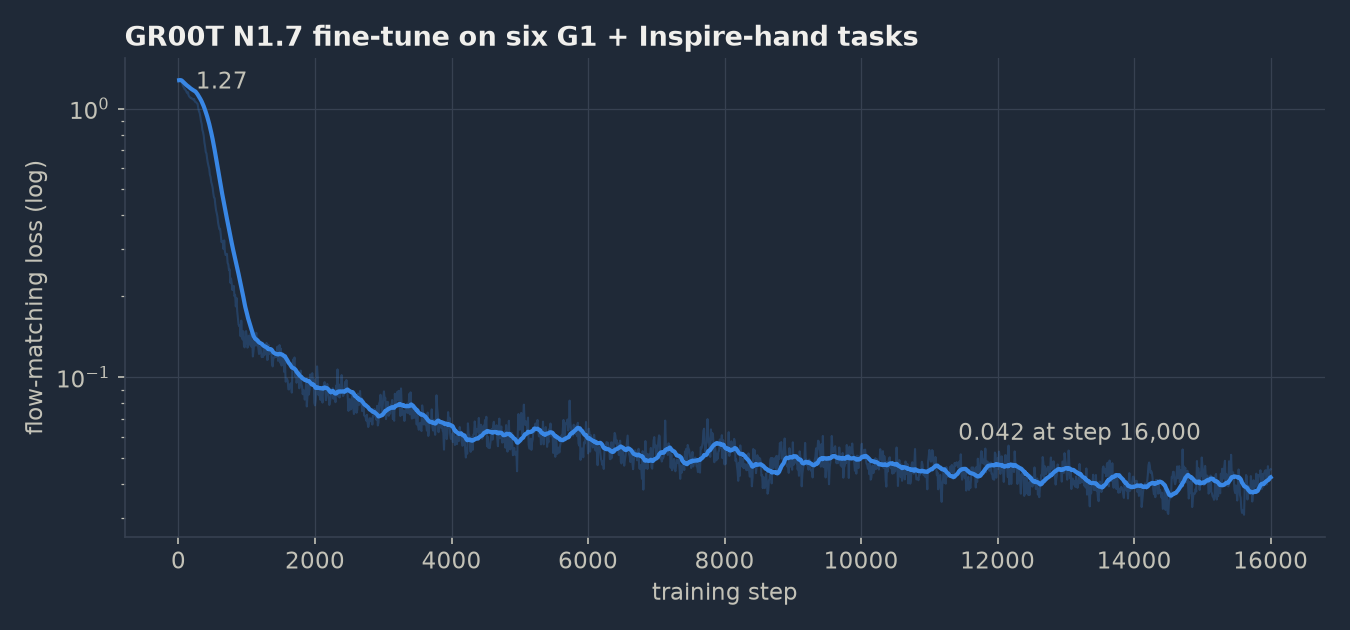
Loss dropped 30x over the first 4k steps and was still trending down when the disk ran out.
Open-loop vs closed-loop evaluation
On held-out validation episodes, I evaluated 16-step action chunks against human teleop trajectories and compared against two baselines: a random-projector model (pretrained VLM backbone + untrained action head, the closest thing to zero-shot for this embodiment) and a stand-still predictor (simply outputting the current pose as the next action, which is surprisingly competitive on slow manipulation data).
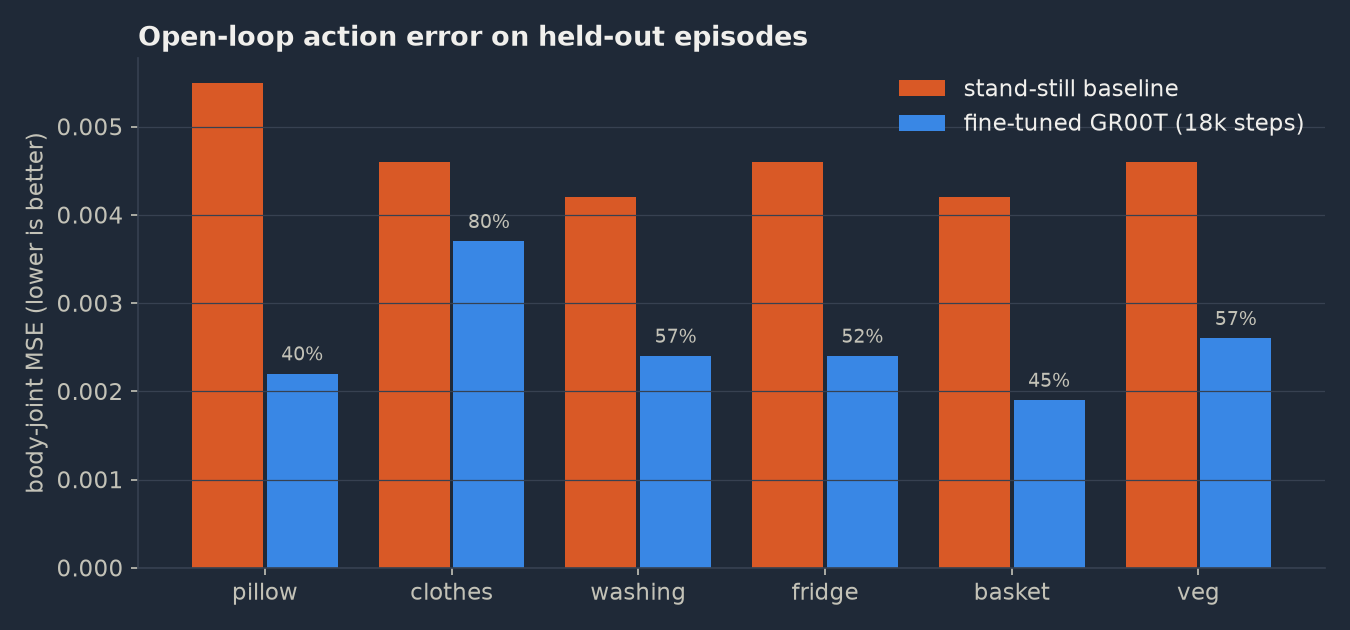
The fine-tuned model reduced MSE by 50–66x over the random projector and beat standing still on all six tasks (40–80% of the stand-still error). Tasks with more data (pillow, basket) did best, while collecting clothes (bimanual, multi-step, and the smallest dataset) was hardest. Hand joint error stayed 5–10x higher than body joint error, which makes sense given the hand head was trained from scratch.
An earlier run on Dex5-hand data also included closed-loop rollouts in MuJoCo, feeding predicted actions back into the simulator. Once errors started compounding, closed-loop MSE was 200–300x larger than open-loop and barely beat standing still, which is a good reminder that open-loop curves only tell part of the story.
Dreaming robot videos with Cosmos-Predict2.5
For the world-model side, I LoRA fine-tuned Cosmos-Predict2.5 2B (Video2World, rank 32 on DiT attention and MLP layers) on just 27 clips drawn from three tasks (pillow, clothes, washing machine), holding out the fridge task completely to check generalization.
Before training worked at all I had to patch the LoRA loader: Cosmos wraps its layers for activation checkpointing, and the loader wasn't stripping that wrapper prefix from parameter names, which left every LoRA target silently unmatched and started the DiT from random weights. Once fixed, training ran for 8,000 iterations on one H100 (~3.6 s/iter, ~296 epochs over the 27 clips). Loss stayed around 0.05–0.13 and validation loss at iteration 7000 (0.078) matched training loss without obvious overfitting.
Each comparison below starts from the same first frame and prompt, with the base model on the left and the fine-tuned model on the right.
The base model has never seen Inspire hands, so its fingers warp and drift off objects. After fine-tuning on 27 clips, the robot approaches grasps cleanly, squats and reaches naturally for objects on the floor, and keeps the 6-DOF fingers coherent. On the unseen fridge scene the output is weaker, though body motion is still plausible enough for filtered synthetic data.
I also tested an earlier Dex5-hand fine-tune on harder single-image prompts:
Recovering actions with an inverse dynamics model
To turn generated videos into policy training data, I trained a 614M-parameter inverse dynamics model (SigLIP2-large vision encoder + DiT flow-matching action head) that takes a video chunk, start state, and instruction and predicts the 41 joint actions (legs, waist, arms, both hands).
At 6,000 steps the loss was still stuck at 0.95 (basically noise) and I nearly killed the run. Letting it run to 30,000 steps (~3.5 hours on an A100) paid off: the loss suddenly dropped around step 15k and finished at 0.13.
| Joint group | Error at 6k steps | Error at 30k steps |
|---|---|---|
| Left leg | 14.5° | 5.6° |
| Right leg | 15.6° | 6.4° |
| Waist | 9.6° | 5.0° |
| Left arm | 16.7° | 8.5° |
| Right arm | 19.8° | 9.7° |
| Left hand | 6.2° | 1.5° |
| Right hand | 14.7° | 10.0° |
| Overall | 13.9° | 6.7° |
Under 6° on the legs and waist is usable, while 8–10° on the arms is fine for coarse reaching but still too loose for dexterous grasps. The full dream → IDM → GR00T pipeline is wired up, though closing the loop at scale is left for later.
Locomotion and parkour in IsaacLab
On a separate track, I trained G1 locomotion and parkour with PPO in IsaacLab across 16,384–20,480 parallel robots on one GPU (~135k sim frames/s). The course has 10 difficulty levels across eight terrain types (flat, stairs up/down, slopes up/down, boxes, stepping stones, and gaps), promoting robots when they walk far enough and demoting them on failure.
I started with a standard teacher-student setup: the teacher reads privileged simulator state (exact terrain height map, contact forces, true velocity) while the student tries to imitate it from onboard observations.
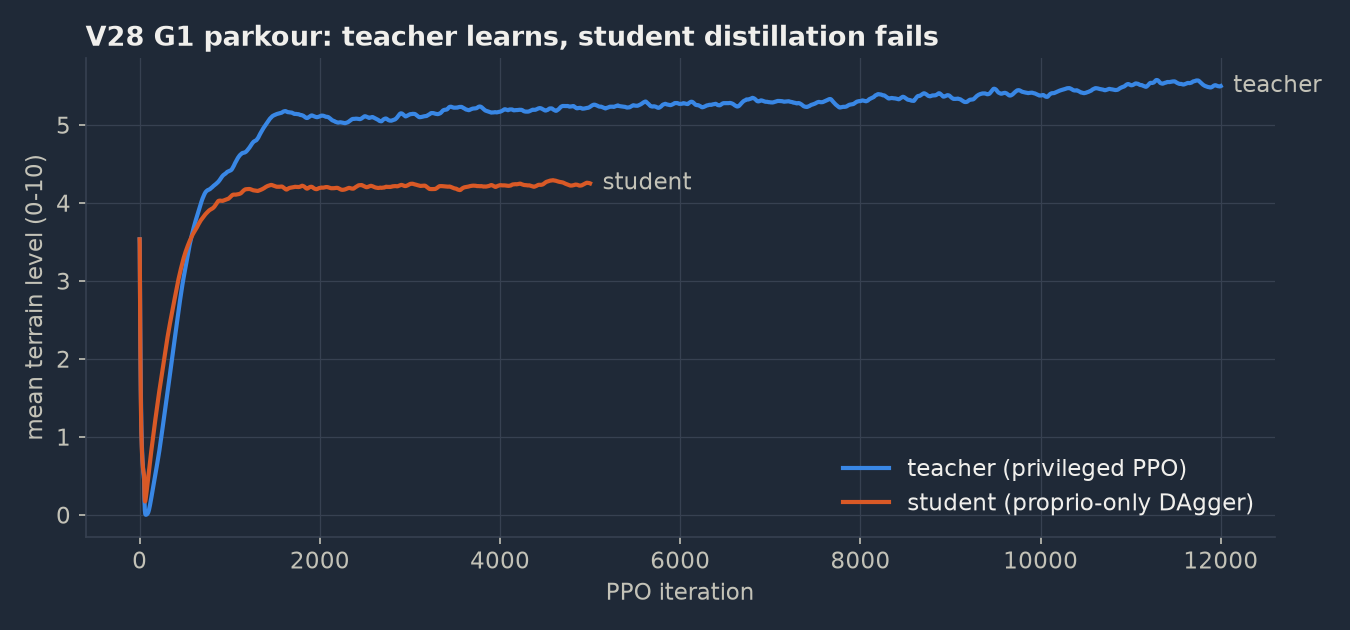
After 12k iterations the teacher reached a 5.3% fall rate and 0.28 m/s velocity tracking error, while the student fell 9x as often and barely committed to steps. It turned out the student observations were missing angular velocity and had too short a history, so distillation couldn't recover behaviors the student had no way to sense.
Most of the progress came from a long sequence of controlled teacher runs (V28 through V55), changing one variable at a time:
- V28b: bigger networks and foot forces in the critic reached the same reward 5x faster, but plateaued at the same ceiling, pointing to environment and reward bottlenecks rather than capacity.
- V28c: fixed an asymmetric limp (one leg hoisted way too high) caused by an over-weighted
feet_air_timereward with no symmetry term, bringing tracking error down to 0.23 m/s and 0.67 rad/s. - V28d: added sim-to-real domain randomization (0–40 ms latency, ±20% motor gains, armature) plus a torque-rate penalty; the penalty overwhelmed task reward on hard tiles and the robot learned to freeze (79% reward drop).
- V28e–n: an MoE actor converged to a deep crouching duck walk, which disappeared immediately when switching back to a plain MLP in V28n.
- V28o: fixed three curriculum bugs, including standing-still commands preventing promotion and IsaacLab's stock curriculum wrapping max-level robots back down to a random level.
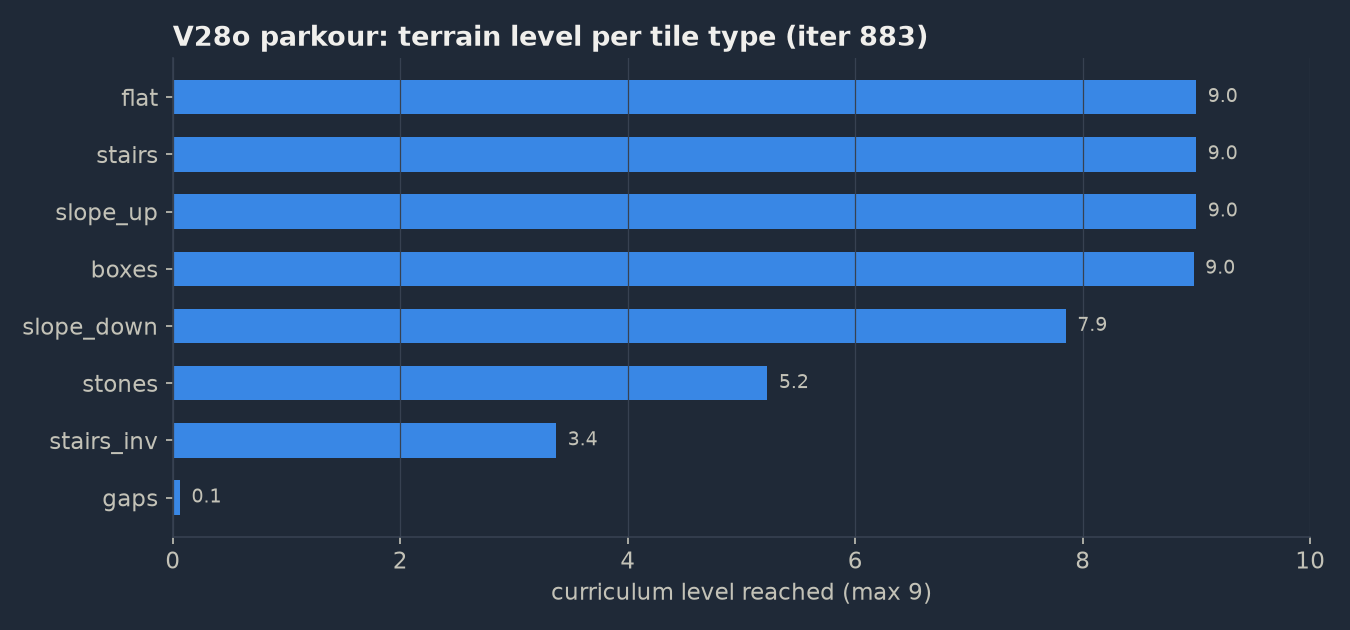
With those fixes, the teacher maxed out flat ground, stairs, uphill slopes, and boxes, and handled downhill slopes and stepping stones well. Gaps remained the sticking point because you can't cross them with a standard stride.
In the follow-up series (V30–V55), I chased gaps and cleaner evaluation:
- V30 maxed out 5 of 8 tile types, but gaps stayed stuck at level 0.43/9. One variant (V30-plain) briefly looked like it hit mean level 8.45, which I retracted after realizing it came from a relaxed promotion rule in my custom curriculum rather than better walking; on IsaacLab's stock curriculum that policy family sits around 5.6–5.8.
- VBaseV2 (stock G1 setup with a stronger step-length reward) reached mean level 5.61, pushed gaps up to 5.91/9, and cut falls to 3.5%.
- V51 added a 5-frame proprioception history and hit level 9 on 7 of 8 terrain types within ~600 iterations (though I didn't log a formal final eval for it).
- Dead ends: a transformer reading a ViT-encoded height map had a 100% fall rate, zigzag parkour plates were ignored, and earlier diffusion / flow-matching / transformer PPO actors peaked at level 3.50/10 with 68% falls, far worse than a plain MLP.
Reconstructing terrain from a head-mounted LiDAR
All of the parkour policies above relied on the simulator's ray-cast height map. To see how close I could get to a real sensor, I simulated a Livox MID-360 (40 channels × 500 azimuths, 30 m range, mounted upside down on the G1's head as on the real robot) and trained encoders to reconstruct the voxelized terrain mesh inside a 3.2 m cube (5 cm voxels) around the robot, following Hoeller et al. (2022).
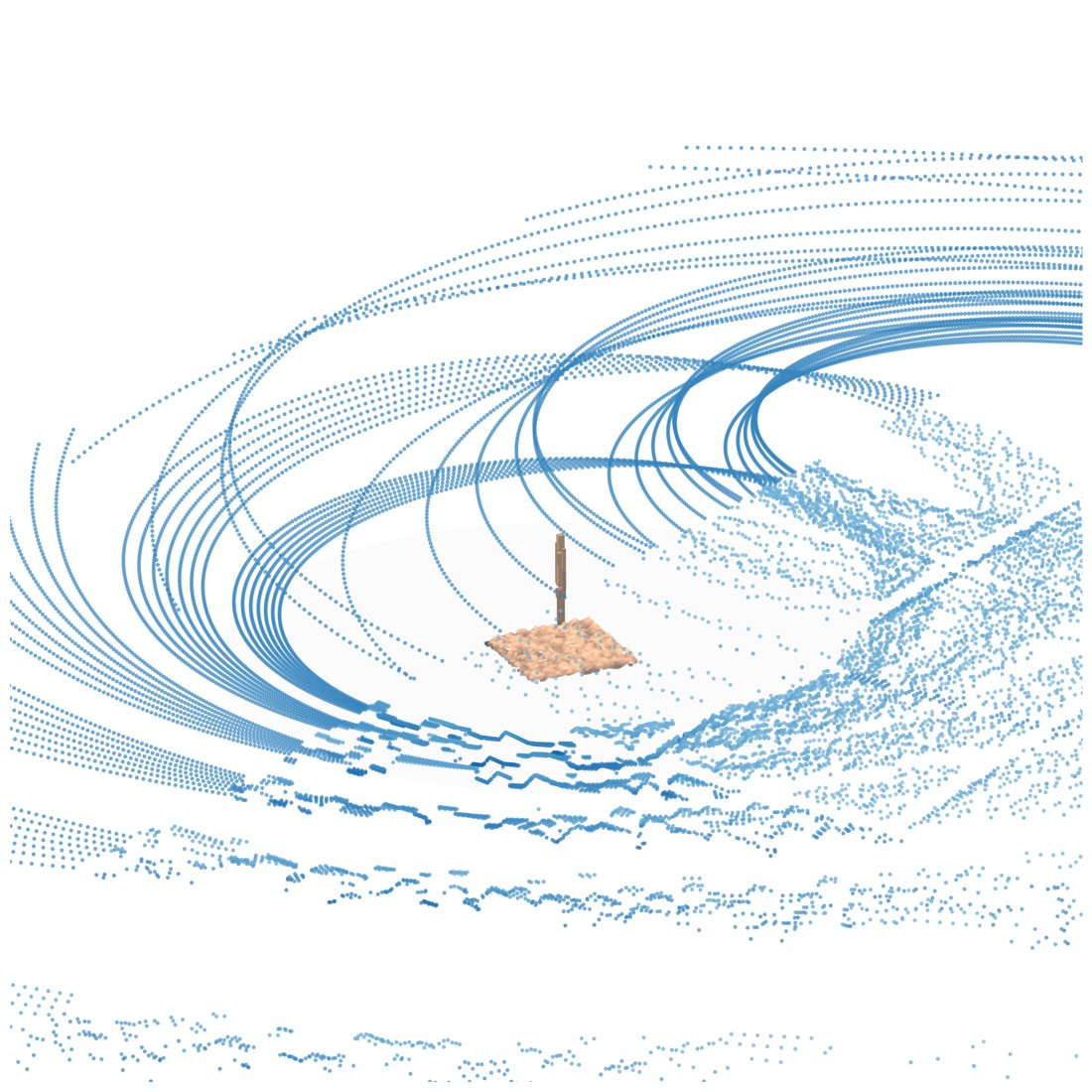
I collected 8,000 frames across 16 environments and 10 terrain types, split by terrain tile so validation tiles were unseen during training, and compared three ~7.2M-parameter encoders:
| Encoder (~7.2M parameters) | IoU @ 0.5 | IoU @ 0.7 | Chamfer (m) | FPS |
|---|---|---|---|---|
| Sparse 4D U-Net (Hoeller 2022 reproduction) | 0.202 | 0.158 | 0.233 | 52 |
| PointNet-style encoder + sparse convolutions | 0.203 | 0.167 | 0.233 | 60 |
| Point-transformer encoder (simplified, attention-based) | 0.189 | 0.112 | 0.243 | 72 |
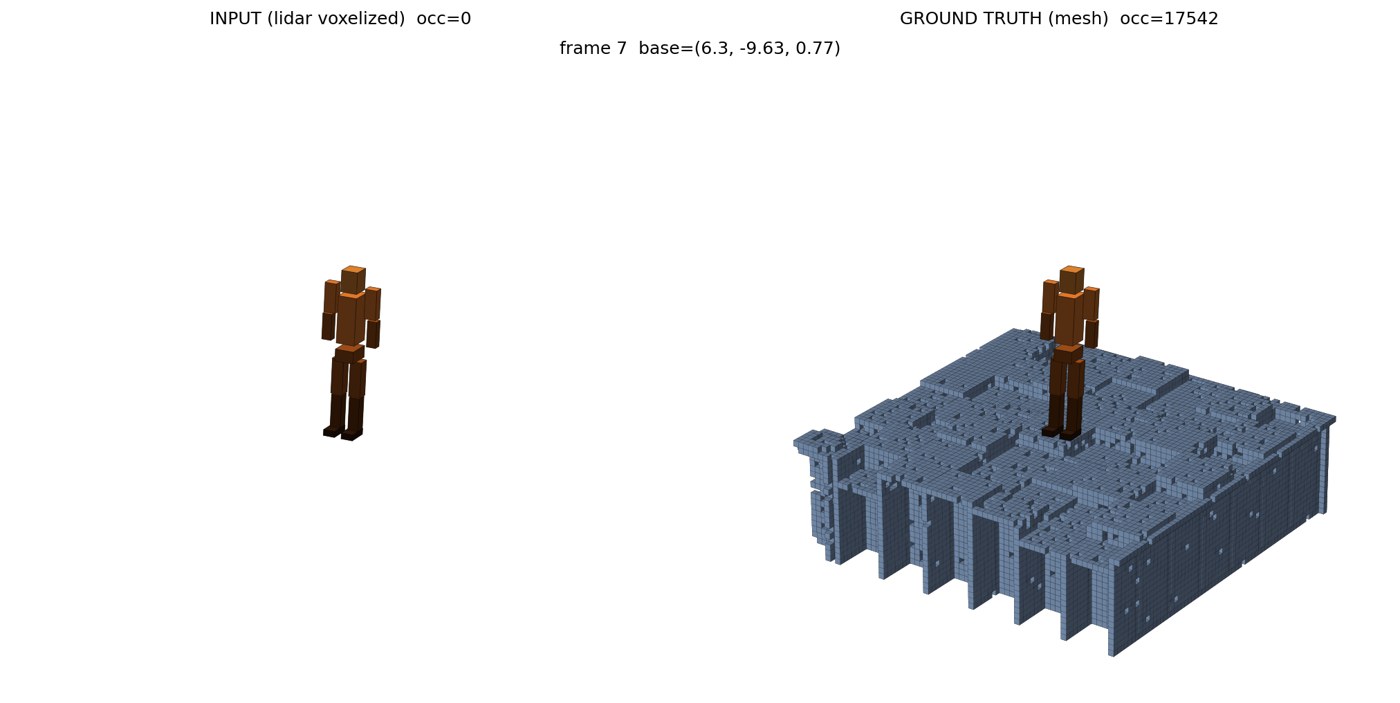
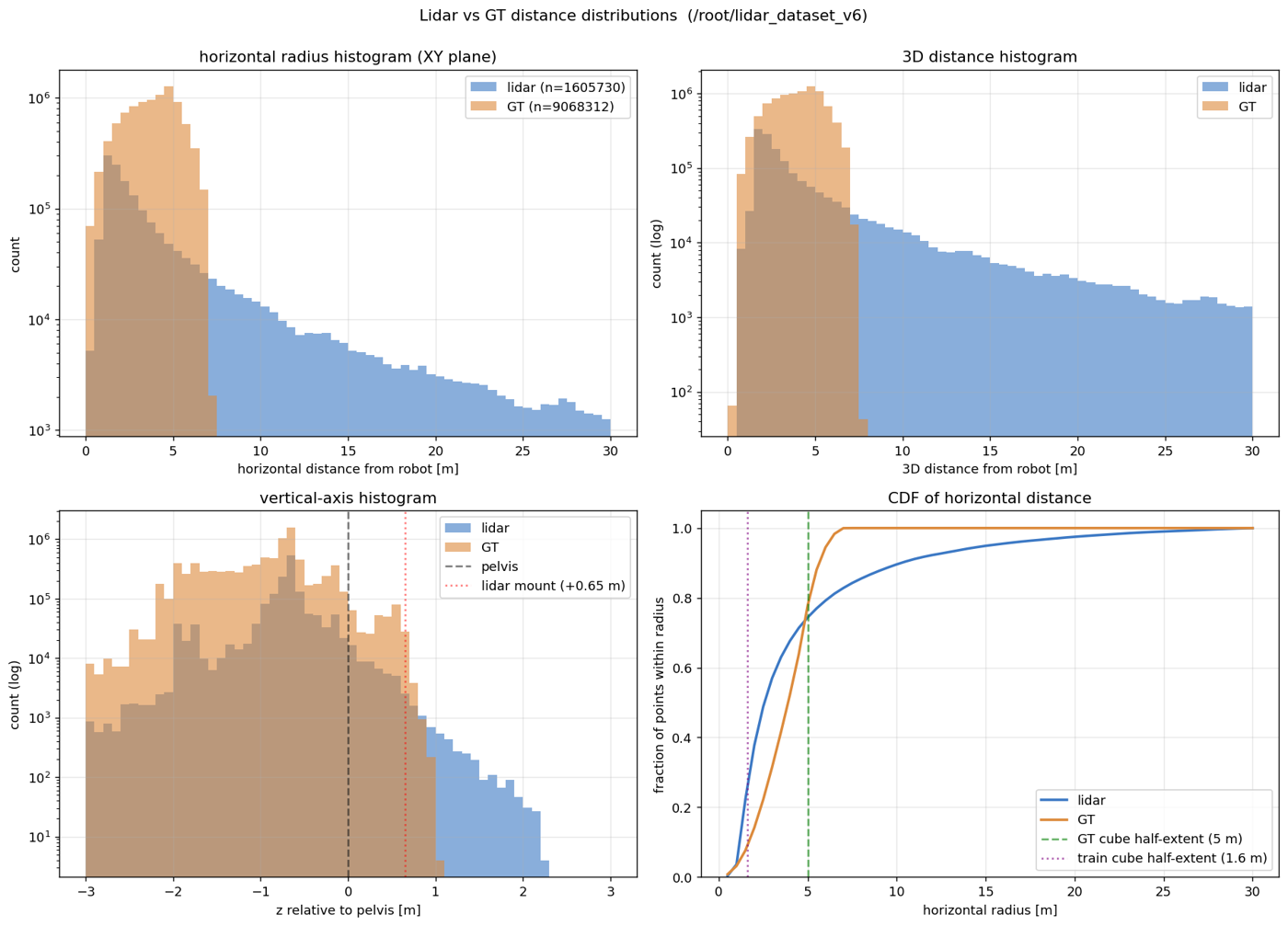
When three different architectures all flatlined at ~0.20 IoU, and training twice as long didn't move the needle, I inspected the raw scans. A head-mounted LiDAR has a huge blind zone right around the robot's feet. In my initial upright mount, the median return was 15 m away and literally zero points landed inside the 3.2 m reconstruction cube:
Flipping the sensor upside down like on the real G1 helped, but even then only about a quarter of the returns fell inside the cube's 1.6 m half-width:
Single-frame reconstruction is fundamentally capped by what the sensor can see from that pose. Solving it requires accumulating scans over time as the robot walks forward (since the ground under its feet was visible a few steps earlier). I started building a per-cell recurrent model and a multi-frame U-Net, though neither has finished results yet and the reconstruction hasn't been plugged into the walker.
JEPA-style latent-action world model
Since GR00T needs action labels and most internet video doesn't have them, I also built a JEPA-style latent-action model. An inverse model looks at two frames and compresses what changed into a small latent code Z; a forward model predicts the future frame's ViT features from the current frame plus Z (initially using a frozen ImageNet ViT-S, later a V-JEPA encoder trained from scratch).
I evaluated this via clip retrieval: given the current frame and a Z, does the predicted future feature vector rank the true future frame first among 100 validation clips? With Z from the inverse model (which sees the future), top-1 retrieval is 97% vs 15% for a "nothing changes" baseline. The real question is whether a prior can generate useful Z without peeking at the future:
| Source of Z (100 validation clips) | Top-1 retrieval |
|---|---|
| Inverse model, sees the future (upper bound) | 0.97 |
| "Nothing changes" baseline | 0.15 |
| Learned deterministic prior | 0.15 |
| Learned flow-matching prior, best of 64 samples | 0.54 |
| Random training-set Z, best of 128 samples | 0.88 |
| Nearest-neighbor training-set Z, best of 512 samples | 0.91 |
Simple nonparametric sampling from training-set Z values handily beat the learned flow-matching prior. (A goal-conditioned prior hit 0.95, but since it receives the true future frame as a goal, it's basically re-learning the inverse model.)
Even without a strong prior, the learned latent space did capture real motion:
- On 13 real hand-object videos, a compact 4×128
Zstill ranked the right clip first 48% of the time out of 2,600 (~1,200x chance). Early runs leaked clip identity intoZ, which an adversarial loss reduced. - On BridgeData V2 robot videos, a linear probe on
Zpredicted real robot actions with R² = 0.26 for gripper position, 0.29 for open/close, and 0.40 for vertical motion (shuffled control ≈ 0). Interestingly,Zcapacity was the only knob that mattered: a 4x smaller dataset gave similar R², and scaling the model from 22M to 51M or 143M slightly hurt. Every configuration also collapsed after ~12k steps, so early stopping was required.
Two side experiments
I also ran two quick LLM-assisted robotics side experiments in Isaac Lab:
-
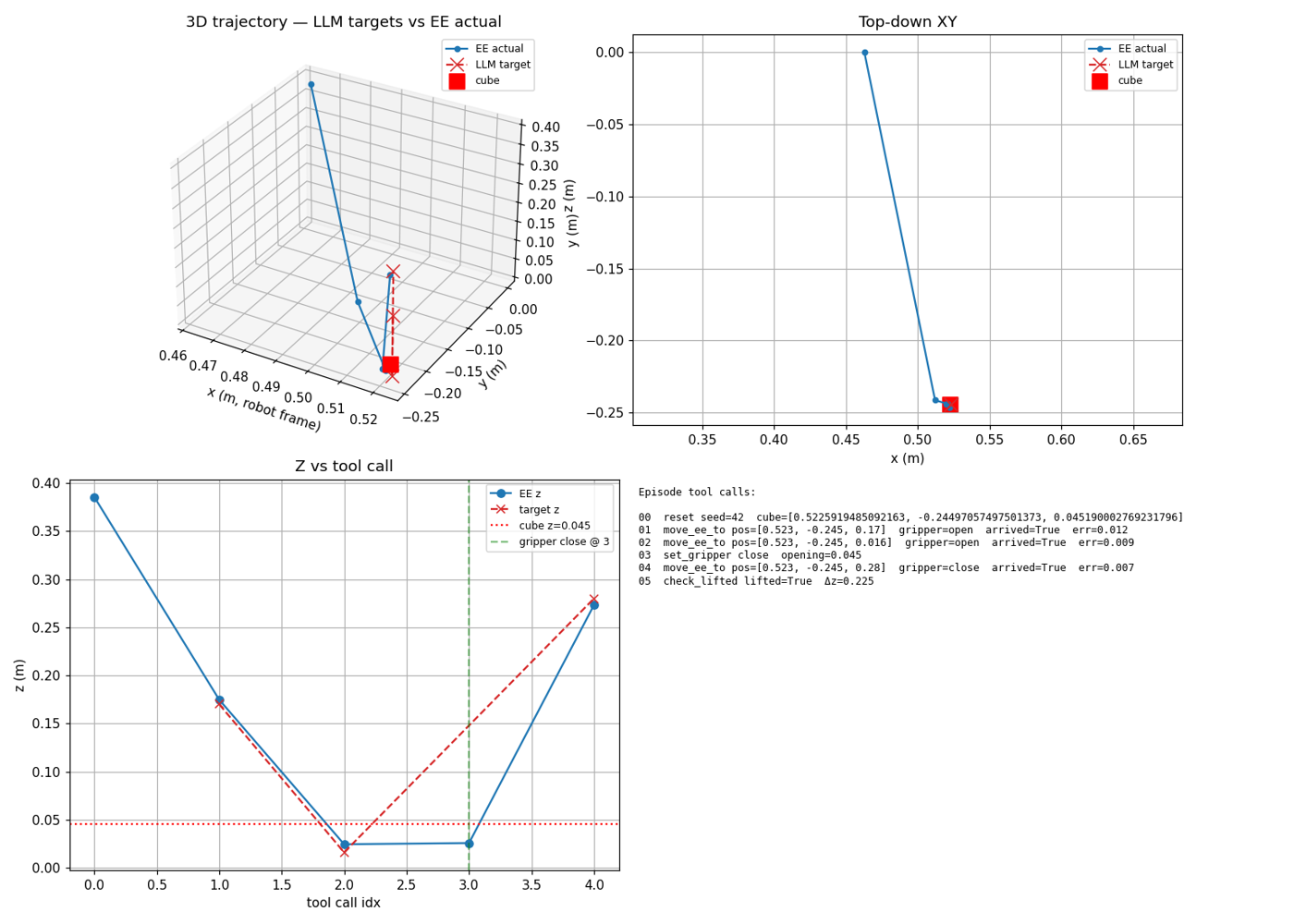
Tool-calling robot control: exposing state queries, end-effector move targets, gripper open/close, and lift checks as tools to an LLM with a 20-call budget. On a Franka arm it picked up the cube in 5 calls; on the G1 upper body the same cube task didn't succeed (single episodes, not a multi-run benchmark).
-
Interactive 3D asset pipeline: an LLM agent that takes a static 3D mesh (a lamp, a drawer, a cash register), breaks it into functional parts, and adds joints and lights so it can be articulated in Isaac Lab. The cash register came out with 42 working keys.
Overall, the pattern across all five tracks was pretty consistent: data plumbing, reward and curriculum bugs, and sensor geometry mattered far more than model architecture, and cheap baselines (standing still for manipulation, sampling training Z for latent actions) caught a lot of ideas that looked better on loss curves than they actually were.