Humanoid Foundation Models for Long-Horizon Mobile Manipulation
I wanted to find out how much of a multi-step household task a single vision-language-action model can handle end to end: pull open a door, walk through it, find a named box in the next room, and pick it up, straight from head-camera images, joint states, and a text prompt.
The setup uses a simulated Unitree G1 with Dex3 hands in Isaac Lab 3.0. I fine-tuned NVIDIA's GR00T N1.7 on demonstrations collected from privileged scripted teachers, running on top of AGILE for leg locomotion.
Trained individually, the skills worked roughly a fifth to a third of the time on unseen sealed layouts: 25/128 clean pull-door passes and 38/128 (29.7%) box picks. Combining them into one end-to-end model turned out to be much harder. A unified model learned the room-B navigation and pick sub-tasks, but lost door approach: from the normal starting pose it rarely walked up and committed to the handle, and even from a pre-reach stance it struggled on fresh layouts. Sequencing the best door and pick checkpoints with an oracle simulator switch reached 12/64 strict (or 13/64 like-for-like vs 6/64 for the single model), capped primarily by how often the door model generalized to new rooms. I have paused the GR00T path here; below is how each stage played out.
| Stage | What was tested | Main result | Eval set |
|---|---|---|---|
| Stage 1: Push door | Single GR00T push-door skill | 82.4% vs 0% blind twin | Unseen layouts |
| Stage 2: Pull door | Grasp handle, pull open, walk through, stop cleanly | 25/128 (95% CI 13.6–27.2%); 23/128 unseen room styles (teacher: 122/128) | Sealed (64 layouts × 2 seeds) |
| Stage 3: Find & pick | Search room, walk to table, bimanual lift | 38/128 = 29.7% (95% CI 22.5–38.1%) | Sealed (64 layouts × 2 seeds) |
| Stage 4: Chained skills | Door model → hand-over at mat → pick model | 7/64 full sequences (2/16 robot-side, 5/48 sim-truth) | Mixed (32 dev + 32 fresh) |
| Stage 5: Custom walker | PPO walker (AGILE recipe) to replace AGILE | Walks & turns, fails 11/25 strict checks (height, slow cmds) | Paused; AGILE kept |
| Stage 6: Single model | One GR00T checkpoint for door → walk → find → pick (v2, v3) | v2: 5/64 full, 27/64 pick, 24/64 door (regressed from 50/64); v3: 21/64 door | Dev layouts (32 × 2 seeds) |
| Stage 7: Oracle switch | v1 door → sim-state switch → scripted walk → v2 pick | 12/64 strict vs 2/64 (p = 0.002); 13/64 vs 6/64 like-for-like (p = 0.065) | Fresh layouts (32 × 2 seeds) |
Pipeline and evaluation setup
Because GR00T trains by imitation, every skill starts with a scripted teacher that reads exact door and box poses from Isaac Lab and records clean trajectories at 50 Hz into LeRobot v2.1 format.
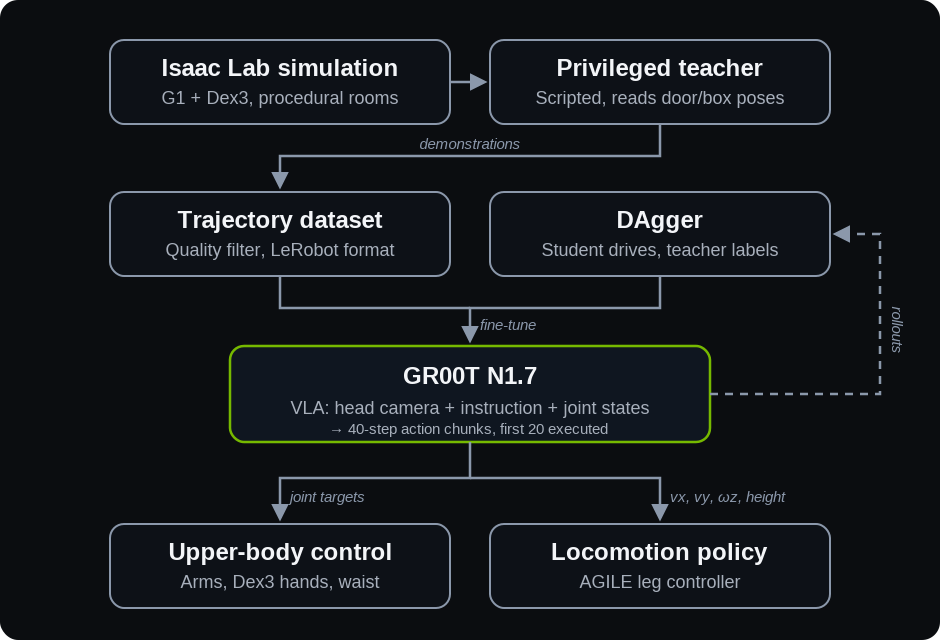
At inference time GR00T receives only the head camera, the text prompt, and its arm/hand/waist joint states (with 40% state dropout during training so it can't ignore vision). It outputs direct upper-body joint targets plus a 4D walking command (vx, vy, ωz, height) sent to AGILE.
Two practical details mattered throughout. First, Isaac Lab runs aren't strictly deterministic (identical starts can vary by up to 23° in door angle), so every video below is an illustrative sample and decisions come from batch rates over 64–128 runs. Second, for stages 2 and 3 I selected checkpoints on development layouts and ran a one-shot evaluation on sealed layouts; later stages (6 and 7) relied on dev and fresh layouts to iterate, and I wrote down pass/stop thresholds ahead of runs to keep myself from moving goalposts after seeing noisy results.
Stage 1: Pushing a door open
I started with a light push door: cross the room, push it open, walk through, and come to a full stop on a mat in the next room. To verify the policy was actually using vision rather than memorizing trajectories from proprioception, I trained a matched blind twin on grey images.
82.4% vs 0% confirmed the vision pipeline worked end to end, so I moved on to a real manipulation task: pulling a door open by its handle.
Stage 2: Pulling a door open with the hands
Here the robot had to grasp the handle with a Dex3 hand, pull against a light door closer (8–15 N at 60°, latching open past 75°), release, steer around the door leaf without bumping the frame (> 50 N fails the clean-pass check), and stand still on the mat for 2 seconds.
Getting from zero passes to consistent clean passages took three rounds of DAgger and a much cleaner teacher:
| Run | Result | Takeaway |
|---|---|---|
| P1: 5k steps, 1,050 demos | 0/256 (same as blind twin) | Proprioception shortcut + too short |
| P2a: larger batch, state dropout, 3k steps | 5/16 opened, 0/16 passed | Started steering from vision, still undertrained |
| Teacher v2/v3 (active gaze, visible stop, noise) + DAgger r1 | 19 → 30/64 opened, 0 clean passes | Better grasp, still clipping frame |
| DAgger r2 (2k → 10k steps) | Worse at 2k; first clean passes at 10k | Had to evaluate at end of full cosine schedule |
| DAgger r3, 10k steps | 25/128 sealed (teacher 122/128); 23/128 unseen retro/storage styles | Held up under visual shift |
| DAgger r3 continued to 15k (fresh warmup) | Dev clean passes dropped 32 → 11/128 | Reverted to 10k checkpoint |
Judging checkpoints mid-schedule was misleading. The first clean passes didn't show up until the end of the 10k cosine decay, while restarting warmup to push to 15k degraded performance sharply.
Stage 3: Finding and picking up a box
Next I trained a pick specialist (starting from the door checkpoint) on 2,016 clean recordings from a scripted search-and-pick teacher (which itself passed 117/128 on acceptance tests, with ~79% of recordings kept). The robot turns to locate a box, walks to the table, and lifts it with both hands.
On dev layouts the model climbed 2 → 9 → 39 → 39 → 38 out of 128 at 4k/8k/12k/16k/20k steps, plateauing around 12k–16k. Picking the 16k checkpoint gave 38/128 (29.7%) on the sealed test. A DAgger correction round dropped to 0/128 at 4k of 12k steps; I stopped it early to free up the GPU, so whether it would have recovered by 12k like the door run remains untested.
Even though the prompts named colors ("pick up the cyan box"), a quick swap test showed the model wasn't actually grounding language. When I changed the prompt to name a distractor box's color, it still picked the original target box 36/128 times (vs 40/128 with the true color) and picked the named distractor 0 times. Because distractors sat outside the target grasp corridor, it relied on scene layout instead of color. Even in stage 6, with a same-size neighbor placed right next to the target, the models still never used the color word (0/64 clean picks of the neighbor, 0/32 layouts solved under both prompts).
Stage 4: Chaining door and pick in one world
With both specialists trained, I put them in a two-room layout where the door model opens the door and stops on the mat, then hands control to the pick model.
The very first evaluation got 0/32 doors and looked like a total policy collapse. Filming a single run immediately showed why: the door model was grasping fine, but I had initialized the wrists in the pick pose (0.148 rad off, nearly matching its first command) and forgotten to enable the 75° door hold-open latch in the combined world, so the door swung shut right back on the robot. Fixing those two harness bugs jumped door openings (> 20°) to 30/32, with 13/32 stopping on the mat and 7/64 full door → pick completions overall (2/16 using the robot's own stop signal, both on the same layout, and 5/48 using a simulator-truth switch).
From there I trained a first joint single model (v1) on the door, pick, and 698 full-sequence recordings. On dev layouts it matched the door specialist (121/256 vs 110/256 clean passes), hit 29/128 (22.7%) on picking, and completed 4/32 full sequences.
Stage 5: Trying to build my own walker
To eventually support stairs and terrain AGILE wasn't built for, I trained my own PPO walker on my home RTX 5070 Ti (4,096 parallel G1s, ~2.2 s/iter, ~5.5 h per 9k iterations) following AGILE's recipe. An earlier stairs walker already descended house staircases 126/128 times in clean sim and 118/128 under torque limits, delay, and randomization. When I dropped the GR00T door model onto it, though, GR00T opened only 0–1 of 8 doors (even the scripted teacher dropped from 8/8 to 3/8). GR00T's upper-body policy is tightly coupled to AGILE's gait and responsiveness to small commands.
Matching AGILE across every command class turned into whack-a-mole:
- The first 9k-iteration clone never fell, but only reached 7% of turn-in-place commands (vs AGILE's 93%) and ignored height targets, which stayed hidden at first because my checks only measured drift.
- Adding pure turn-in-place commands fixed turning (63%) but crashed survival with moving arms down to 27–44%.
- Training with both turn commands and arm motion gave my best checkpoint (3 falls in 1,024 robots on one arms-moving test, 0 across 27 other checks including 1 kg per hand), yet it still failed 11 of 25 strict tracking criteria (standing height, stop overshoot, slow 0.1 m/s walking, yaw drift during strafing).
- A follow-up height + slow-command fix (after catching a sampling bug that cut standing robots from 64% to 18%) reduced standing height error from 0.094 m to 0.036 m, but regressed slow turning and left 0.1 m/s broken. Fine-tuning AGILE directly also failed; a small residual correction on top of frozen AGILE looked close, but I paused walker work on November 16 and kept AGILE under GR00T.
Stage 6: One GR00T model for the whole mission
Returning to the main goal, I upgraded the scripted teacher for v2 so its arms hung naturally while walking (instead of sticking forward 98% of the time), cut sideways walking from 34% to 13%, removed an awkward look-back after the door, added ~1,800 prompt phrasings plus navigation sub-tasks ("go to the desk", "walk through the door"), and filtered out demos that knocked objects > 5 cm. That produced 1,322 recordings (1,984 weighted training copies, 5.5M frames; even the teacher only completed 130/192 full rooms at scale). I fine-tuned from v1 for 25k steps (4.6 h).
Paired comparison of v2 vs v1 on the same 32 dev layouts × 2 seeds:
| Metric (32 dev layouts × 2 seeds) | v2 | v1 | Notes |
|---|---|---|---|
| Full sequence (door → pick) | 5/64 | 1/64 | Not significant (p = 0.22); v1 scored 4/32 in its own setup/wording |
| Pick target box (room-B start) | 27/64 | 10/64 | Much of the gap is wording; with v1's own phrasing it got 8/32 vs v2's 13/32 (p = 0.27) |
| "Go to box" / "Go to desk" | 43/64, 40/64 | 2/64, 3/64 | New sub-tasks added in v2 |
| Door opened ≥ 45° (door-only) | 24/64 | 50/64 | Major regression; clean door passes also fell 23 → 15/64 |
| Falls (worst test) | 1/64 | 4/64 | 0 falls on all other tests |
v2 walked more naturally (hands held forward dropped from 98% to 11% of walking time, with smoother turning, though arm jerk stayed ~250× the teacher and ~1/3 higher than v1), learned the new navigation commands, and bumped picks. On the downside, it wrecked door reliability: 24/64 vs 50/64 doors opened ≥ 45°, and clean door passes inside full runs fell 13 → 8/64, failing my non-inferiority check.
Diagnosing the door drop and testing v3
When I started v2 right at the teacher's pre-reach stance in front of the handle, it opened the door 26/32 times vs v1's 27/32 (compared to 13/32 vs 25/32 from the normal start on the same layouts). So on dev layouts, the pull skill was still there; it had just lost the approach and commitment to reach, likely because I had cut door-phase window sampling from 50% down to 25% while adding "go to X and stop" data.
For v3, I raised door-approach weight 2.4× (to 9.6% of samples) and trained 12k steps from v2 on 2,016 recorded episodes: 1,322 from v2 plus 694 new ones (including 431 door starts and 61 short "go to" clips from a more varied room generator), re-weighted into 3,109 training copies / 9.0M frames. The snapshot was taken early, below my original target of 1,500 new episodes.
| v3 vs v2 (paired, same session) | v3 | v2 | Notes |
|---|---|---|---|
| Door ≥ 45° (door-only, dev) | 21/64 | 27/64 | Target was ≥ 40/64 (p = 0.33) |
| Full sequence (dev) | 3/64 | 4/64 | Target was ≥ 12/64 |
| Pick box (room-B start, dev) | 27/64 | 26/64 | Unchanged |
| "Go to box" / "Go to surface" (dev) | 36/64, 41/64 | 37/64, 32/64 | Surface p = 0.049 raw (~0.34 adjusted) |
| Fresh layouts (32 × 2 seeds): door / full | 22/64, 4/64 | 17/64, 0/64 | p = 0.33 and 0.125; harder for both |
| New room generator (40 rooms, 1 seed): door / full / pick | Base (32): 9, 2, 16; Island (8): 2, 1, 5 | Base: 15, 1, 15; Island: 3, 1, 4 | Teacher completes 31/40; no significant diff |
| Falls | 0 across all v3 evals | ||
v3 didn't fix the door, so v2 stayed my single-model baseline. Even worse, running the pre-reach diagnostic on fresh layouts showed that both v2 and v3 still completed only 2/32 full sequences (opening the door 14/32 and 22/32 times despite palms reaching within 0.08–0.10 m of the handle). On unseen layouts, handle grasping itself was fragile, not just the approach.
Stage 7: Testing an oracle switch between two skills
Before spending time building a learned high-level controller, I wanted an upper bound: if a simulator-state oracle switches between my strongest door model (v1) and pick model (v2), and a scripted route walks cleanly through the doorway in between, how much does it beat single-model v2?
Whenever the simulator reported door angle ≥ 45° with both hands off the handle (or at a 75 s timeout), the scripted doorway walk took over and stopped on the mat, then v2 searched and picked until 150 s. I ran both setups paired on 32 fresh layouts × 2 seeds (fresh to training and controller tuning, though previously seen during v3 and the hybrid diagnostic; v1's door phrasing was picked as the better of two on dev layouts, 50 vs 39/64, which slightly inflates its dev baseline).
| Fresh layouts (n = 64 paired) | Oracle sequenced | Single v2 | Paired test |
|---|---|---|---|
| Full sequence, strict | 12/64 (95% CI 11–30%) | 2/64 | 10 vs 0, p = 0.002 |
| Like-for-like (door ≥ 45° + clean pick) | 13/64 | 6/64 | 9 vs 2, p = 0.065 (n.s.) |
| Door opened ≥ 45° | 32/64 | 21/64 | |
| Reached the mat | 31/64 | 14/64 | Scripted for sequenced arm |
| Pick stance / clean pick | 19/64, 13/64 | 8/64, 6/64 | |
| Falls | 0/64 | 0/64 |
The strict metric (12/64 vs 2/64) gave the sequenced pipeline a built-in advantage because the scripted walk guaranteed a clean zero-velocity stop on the mat. Removing that clause narrowed the gap to 13/64 vs 6/64 (p = 0.065), right in the middle of my proceed (≥ 16/64) and kill (≤ 8/64) thresholds.
The breakdown made the bottleneck obvious. Of the 31 robots that actually opened and released the door, all 31 reached the mat and 13 picked the box cleanly, matching v2's standalone room-B pick rate (26/64). None of the 33 timed-out robots recovered. Sequencing worked about as well as door_rate × pick_rate, and v1's door rate fell from 50/64 on dev layouts to 32/64 on fresh ones (just as v2 dropped 27 → 17/64). Even with an oracle switch and scripted doorway walk, door generalization to new rooms was the ceiling.
Stage 8: RL skill teachers, and what "clean" really means
The GR00T results pointed at the teachers: an imitation student can only be as good as the demonstrations it copies. So I switched to training the skills themselves with reinforcement learning, the way recent humanoid stacks do it: privileged PPO teachers in Isaac Lab that read exact simulator state, run over a frozen AGILE leg controller, and output 17 upper-body joint targets plus a walking command at 50 Hz. The plan is to distil them into a camera student later. The catalogue so far is box pickup, box carry, box drop-off and button push, plus a mission that chains pickup, carry and drop-off in one episode.
The first round looked great on paper: pickup 96.9%, carry 93.4%, button 99.6%, and the full mission 70.1% (later 80.9%). Then I watched the videos. The button was mostly hit with the knuckle, and the arm stayed parked overhead afterwards. Drop-off slammed the box onto the table. So I wrote a stricter evaluation contract (fingertip-only press under 20 N, touchdown under 0.5 m/s, no table contact over 30 N during the whole episode, arms back at rest) and more realistic physics (hand friction 0.3 instead of an effective 1.0, tables with legs, a spring-loaded button with 4 mm travel), and re-scored the same checkpoints without retraining.
| Skill | Original criteria | Strict contract + realistic physics | Main failure |
|---|---|---|---|
| Pickup | 96.9% | 68.0% | Hips and legs bump the table during the approach |
| Carry | 93.4% | 77.7% (48.0% chained after pickup) | Heavy boxes slip at realistic friction |
| Drop-off | 68.4% | 0.8% | Box hits the table at 1.7 m/s (median) |
| Button | 99.6% | 0/256 | Knuckle strike (48 N median), arm parked overhead |
| Mission | 70.1% | 0/512 | All of the above |
Retraining from scratch with a clean-teacher recipe
I asked three frontier models to review the code and data independently and propose a recipe. I followed the one they broadly agreed on: retrain every skill from scratch with target smoothing and rate limits inside training (not just at eval), a much stronger smoothness penalty, every "never" clause of the contract turned into an episode termination at the moment it happens (loose at first, tightened over a few hundred iterations), less exploration noise, and the realistic physics from step one.
Pickup retrained this way scored 477/512 = 93.2% under the strict contract on two fresh seeds read once, up from 67.6% for the old checkpoint on the same seed. The button took three attempts. The first two never pressed once. The policy's fingertip estimate turned out to sit 1.7 cm short of the real fingertip. With that fixed, the final checkpoint reached 92.6% under the strict contract on two fresh seeds read once: every press latched on the fingertip, with peak force 11 N median. It still missed two of its own quality limits by a hair (force p90 16.5 N against 16 N, arm rest p90 0.213 rad against 0.20).
The numbers passed, the video didn't
The new pickup passed every gate I had registered, but in the video the fingers seemed to sink into the box, and the grip looked odd. Measuring it explained both. The thumb's collision shape in the robot model is a 20 × 30 × 20 mm box inside a much larger thumb mesh, and the wrist link has no collision shape at all. The policy had learned to clamp the box between those two hidden thumb boxes: they carried 78% of the holding force, while the palms never touched the box (24–31 mm away). The visible thumb sat about 5 mm inside the box, the robot stayed crouched with the box at head height, and the first contact hit at 126 N (median) even for boxes under 1 kg.
None of this showed up in a success rate. A second independent review of every environment came to the same conclusion and produced a "clean environment standard" that each environment now has to pass before any training: collision shapes within 1–2 mm of the visual meshes, self-collision on, friction measured per material pair, a scripted solution that succeeds at least 95% of the time, and demonstration-quality gates on top of task success (at least 70% of the grip force through palm and finger pads, no body contact with the box, approach under 0.2 m/s, grip at most twice what the box needs, pelvis above 0.70 m, box at least 10 cm below the head). I'm rebuilding the hand collision geometry and the checks now; the skills get retrained once their environments pass.
Compute, datasets, and notable bugs
| Details | |
|---|---|
| Hardware | Rented RTX PRO 6000 Blackwell (96 GB), 1 TB disk for GR00T training, recording, and eval; local RTX 5070 Ti (16 GB) for the PPO walker. |
| Training runs | Door r3: 10k steps (2 h 19 m). Pick: 20k steps (4 h 30 m). Single v1: 25k (~6.5 h). Single v2: 25k (4.6 h, 1.5 steps/s). Single v3: 12k (2 h 16 m). Walker: 9k PPO iters (~5.5 h). |
| GR00T recipe | Started from NVIDIA's G1-Factory-GR00T-1.7 checkpoint; trained vision encoder, projector, and diffusion action head (LLM frozen); batch 48, cosine lr (2e-5 door, 1e-5 pick), color jitter, 40% state dropout. Full checkpoints ~27 GB each. |
| Datasets | LeRobot v2.1 (Parquet + 50 Hz MP4). Door: 3,794 eps / 9.6M frames / 63 GB. Pick: 2,016 eps / 3.3M frames / 18 GB. Combined mix: 6,508 eps / 15.7M frames. |
| Orchestration | Isaac Lab 3.0 batched sim (32–128 eval layouts in parallel, 4,096 robots for PPO) managed via tmux watchers that trigger evals, prune checkpoints to keep ≥ 97 GB free, pause on NaN/spikes, and MD5-sync artifacts off ephemeral pod storage. |
A few subtle evaluation bugs nearly burned me along the way:
- Shortening the mat-stillness window from 2 s to 0.4 s for single-model runs let robots pass while creeping forward at 0.1 m/s; I added a requirement that commanded velocity stay zero across the full 0.4 s.
- The
v3verification script compared an integer against a dictionary when cross-checking full-sequence totals against per-robot JSONs, silently passing vacuously until a tamper test (injecting bogus counts of 99) caught it before the final eval. - My
v3training logs initially printed 3,109 "episodes", which were actually re-weighted copies of 2,016 recordings (only 694 new), and stage 7 initially highlighted only the strict p = 0.002 result without the 13 vs 6 like-for-like check. I corrected both here.
Where it goes from here
I'm pausing the GR00T fine-tuning track here. Improving it would mostly mean collecting much more diverse door-approach data across varied rooms and testing a real onboard hand-over rather than a simulator switch. The current focus is the RL skill catalogue from stage 8: clean environments first, then clean teachers, then a camera student distilled from them.